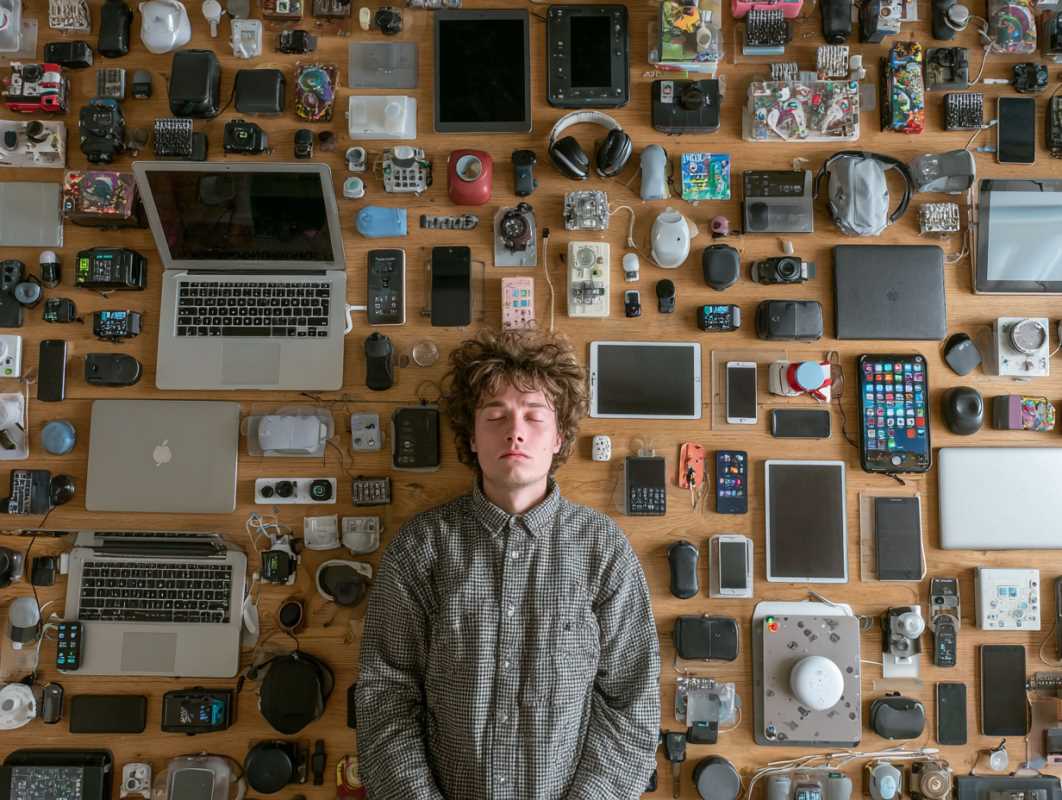
 (Image source: Midjourney)
 We live in an era where our phones are practically glued to our hands, and the boundary between work, leisure, and scrolling has completely dissolved into one endless stream of notifications. It feels like every time we look away from a screen, we hear a ping, a buzz, or a ding demanding our attention back immediately. This constant barrage of information isn't just annoying; it is genuinely overwhelming our brains and taking a serious toll on our mental well-being, focus, and even our physical health. Managing digital overload isn't about tossing your smartphone into a river and moving to a cabin in the woods; it is about finding a realistic balance that lets you use technology without letting it use you.
Understanding the Digital Drain
Digital overload happens when the volume of information we are exposed to exceeds our brain's processing capacity. It's like trying to drink from a fire hose. Our brains are wired to seek out new information—a survival trait from our hunter-gatherer days—but they aren't evolved to handle the millions of data points thrown at us daily by the internet.
When you are constantly switching between emails, texts, news alerts, and social media feeds, your brain releases cortisol, the stress hormone. Over time, this chronic low-level stress can lead to:
- Brain Fog: Difficulty concentrating or thinking clearly.
- Sleep Issues: The blue light and mental stimulation keep you awake.
- Anxiety: The fear of missing out (FOMO) keeps you on edge.
- Physical Strain: "Tech neck" and eye strain are real physical symptoms of digital overuse.
Curate Your Feeds ruthlessly
One of the most effective ways to manage the noise is to control the source. Think of your social media feeds and email inboxes like your home. You wouldn't let just anyone walk in and start shouting in your living room, so why let them do it on your phone?
Take an hour this weekend to audit your digital environment. Go through your social media lists and unfollow or mute accounts that make you feel inadequate, angry, or stressed. If an account doesn't educate, entertain, or inspire you, it doesn't deserve your attention.
The same goes for your email. That newsletter you signed up for three years ago to get a 10% coupon? Unsubscribe. Every unread email is a tiny visual clutter that adds to your mental load. Cleaning this up stops the overload at the source.
The Power of "Do Not Disturb"
Most of us treat notifications as urgent commands. A phone buzzes, and we instinctively reach for it like trained Pavlovian dogs. But very few notifications actually require an immediate response.
You need to reclaim your right to focus. Most modern smartphones have robust "Do Not Disturb" (DND) or "Focus" modes. Use them.
- Scheduled DND: Set your phone to automatically go into silent mode during your most productive hours or during dinner time.
- App Limits: Set daily time limits for "problem apps" (usually social media or games). When the time is up, the app greys out. It’s a gentle reminder to move on.
- Batching: instead of checking email every 5 minutes, check it three times a day at specific times. This simple shift can drastically lower your stress levels.
Create Physical Boundaries
Sometimes digital boundaries aren't enough; you need physical ones. If your phone is on your nightstand, you are going to look at it. If your laptop is open on the kitchen table, you will check work emails during breakfast.
Designate "Tech-Free Zones" in your house. The bedroom is a great place to start. Ideally, your bedroom should be a sanctuary for sleep and relaxation, not scrolling. Buy an old-school alarm clock so you don't need your phone to wake up.
The dining table is another excellent tech-free zone. Eating while distracted can lead to overeating because you aren't paying attention to your body's fullness signals. By banning screens from the table, you reconnect with your food and the people you are eating with.
The 20-20-20 Rule for Eye Health
Digital overload hits your eyes hard. We stare at screens so intensely that we actually blink less often, leading to dry, strained eyes. To combat this, adopt the 20-20-20 rule.
Every 20 minutes, take a break for at least 20 seconds and look at something 20 feet away.
This simple exercise relaxes the focusing muscles inside the eye and reduces fatigue. It also serves as a mental reset button, giving your brain a tiny micro-break from processing pixels.
Reconnect with the Analog World
To truly beat digital overload, you have to remember what the real world feels like. We often scroll because we are bored or looking for a dopamine hit. We need to replace that digital habit with an analog one.
Pick up a hobby that requires your hands. You can't scroll Instagram if you are knitting, gardening, painting, or baking bread. These tactile activities force you to be present in the moment. The satisfaction of creating something tangible is far deeper and longer-lasting than the fleeting joy of a "like" on a photo.
Go outside without your phone. This sounds terrifying to some, but try a short walk around the block without your device. Notice the trees, the air, the sounds of the neighborhood. Without a podcast in your ears or a map on your screen, your brain enters a "default mode" which is crucial for creativity and problem-solving.
Establish a Digital Sunset
Just as the sun goes down to signal the end of the day, you should have a "digital sunset." The blue light emitted by screens tricks your brain into thinking it's still daytime, suppressing the production of melatonin, the sleep hormone.
Choose a time—say, one hour before bed—where all screens go off. This is your wind-down period.
- Read a physical book.
- Journal about your day.
- Do some light stretching.
- Prepare your clothes for tomorrow.
This routine signals to your body that the day is over and rest is coming. You will fall asleep faster and get deeper, more restorative rest, which in turn makes you more resilient to stress the next day.
The "Grayscale" Trick
If you find yourself addicted to the colorful candy-crush nature of your phone's interface, try switching your screen to grayscale.
Tech companies design app icons with bright, stimulating colors (specifically reds and notifications badges) to grab your attention. By burying the color settings in your phone's accessibility menu and turning everything to black and white, the phone instantly becomes less stimulating. Instagram looks remarkably boring in grayscale. It turns your phone back into a tool rather than a toy.