Walk into almost any traditional gym, and you'll see people glued to weight machines or waiting in line for a bench press. There's a persistent myth floating around fitness culture that you cannot build serious muscle or elite strength without iron plates.
Your muscles don't have eyes. They can't tell whether mechanical tension comes from a cast-iron barbell or gravity acting on your own body mass. What your nervous system understands is load, mechanical tension, and proximity to fatigue. Recent research shows that when you push sets within a few reps of failure, bodyweight training builds comparable muscle thickness to traditional barbell lifting.¹
Stepping away from machines forces you to control your body through space. You build functional stability, balance, and spatial awareness that transfer directly into everyday life. Once you master the mechanics of moving your own weight, the world becomes your training ground.
Mastering the Foundational Movements
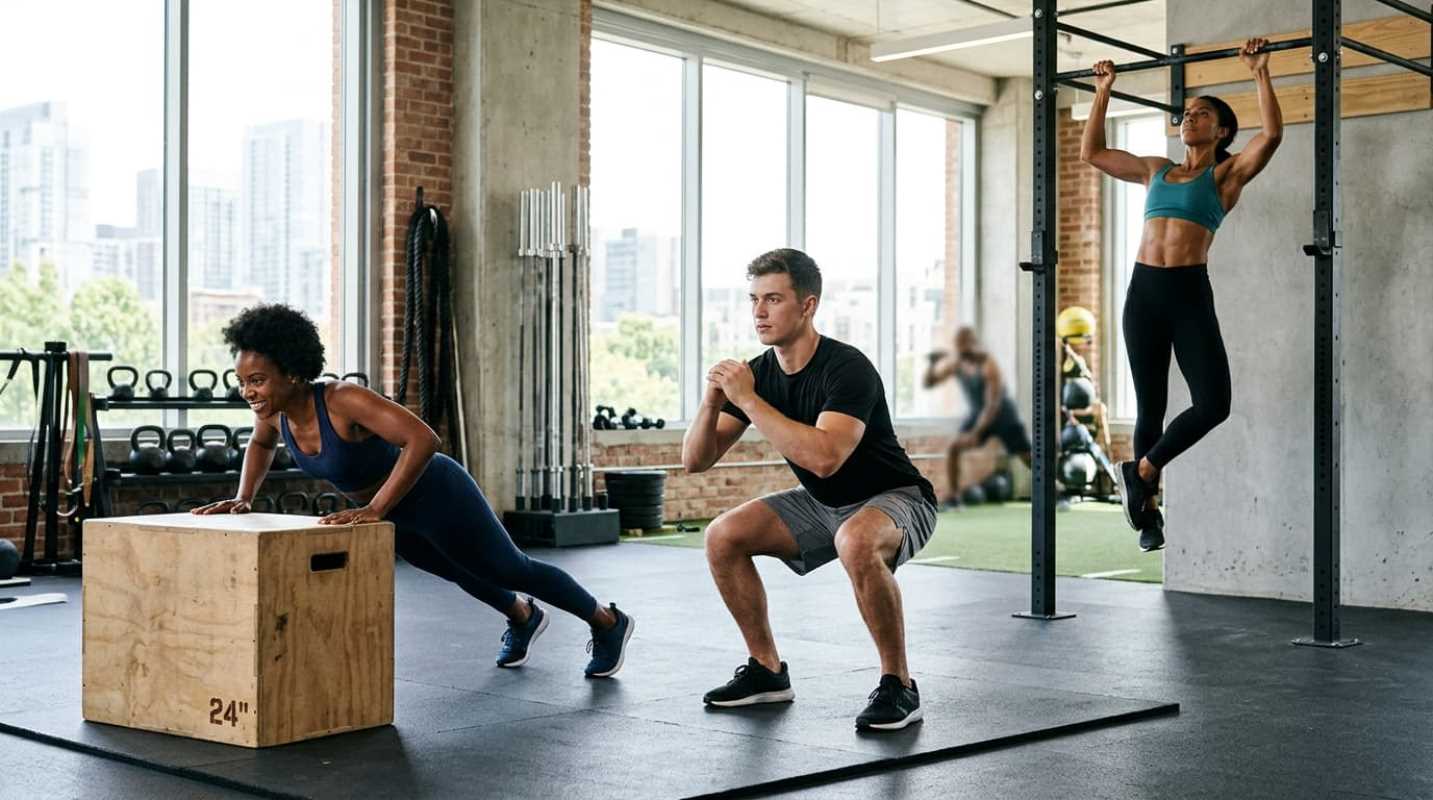
Before you try to hold an iron cross or balance on your hands, you need to own the basics. The foundation of all bodyweight programming rests on four fundamental movement patterns: push-ups, squats, pull-ups, and lunges.
Think of these foundational movements as the bedrock of your strength. Piling fancy variations on top of sloppy mechanics is a fast track to shoulder impingement or cranky knees. You want a full range of motion on every rep. That means chest to the floor on push-ups, breaking parallel on squats, and achieving a dead hang at the bottom of every pull-up.
If you can't hit standard versions yet, don't skip the movement. You modify your angle to find an honest starting line
• Incline push-ups: Placing your hands on an elevated surface like a bench drops the resistance from 64 percent of your body mass to around 41 percent.
• Box squats: Sitting back onto a stable chair teaches hip hinge mechanics and builds confidence in knee tracking.
• Assisted pull-ups: Looping a resistance band around your foot or using an inverted bodyweight row lets you build your back without fighting your full body weight immediately.
• Static split squats: Keeping your feet planted removes the balance challenge of walking lunges so you can focus on pure leg drive.
Spend time owning these basics. Build up until you can perform three clean sets of ten to fifteen standard push-ups, twenty solid air squats, and five to eight dead-hang pull-ups before hunting for harder tricks.
The Art of Making Exercises Harder
In a weight room, making an exercise harder is simple: you slide another ten-pound plate onto the bar. With bodyweight training, you don't add mass. You alter physics.
The primary way you increase resistance is by manipulating moment arms. In simple terms, torque equals force multiplied by distance. When you extend the distance between your joints and your center of mass, your muscles must work exponentially harder to resist gravity. Think of holding a heavy grocery bag close to your chest versus holding it at arm's length. The bag weighs the same, but your shoulders feel a world of difference.²
Beyond changing your joint angles, you have several powerful tools to ramp up intensity
• Cadence and pauses: Slowing down your tempo strips away momentum. Try lowering yourself for three full seconds, pausing at the bottom for one second to kill the elastic recoil in your tendons, and exploding upward.
• Deficit ranges: Using parallettes or elevation blocks lets your chest drop below your hands during push-ups, stretching the muscle fibers through an extended range of motion for a deeper growth stimulus.
• Unilateral loading: Shifting your body mass onto a single limb immediately cuts your base of support and doubles the demand on the working side.
Scaling to Advanced Calisthenics
Once standard movements feel like a warm-up, it's time to climb the movement ladder. You don't jump directly from a standard push-up to a one-arm push-up. You use stepping stones.
Archer variations are the perfect bridge. During an archer push-up or archer pull-up, you shift most of your weight onto one working arm while extending the other straight out to the side as a light stabilizer. As you get stronger, you place less and less pressure on that assisting hand until you no longer need it. From there, you unlock full pistol squats, wall-supported handstand push-ups, and elevated decline presses.
Advanced bodyweight training also introduces high-level isometric holds, such as the front lever and the planche. These static positions require massive whole-body tension and straight-arm joint strength.
Here's an important reality check: muscle adapts to training stimulus within weeks because it has a rich blood supply. Your tendons and connective tissue, but they adapt far more slowly. It often takes six to twelve weeks for tendons to remodel under heavy straight-arm loads. If you rush these static progressions, your elbows and shoulders will pay the price.
Mastering these movements demands a psychological shift. You won't be adding five pounds to a barbell every week. Progress might mean holding an advanced tuck position for two seconds longer, or straightening your legs by just an inch. You have to learn to fall in love with micro-progress.
Building a dedicated calisthenics practice requires very little gear, but a few basic tools can make your progression smoother and protect your joints.
Structuring Your Routine for Consistent Gains
Consistency beats novelty every single time. A simple full-body routine performed three days a week, or an upper-lower split performed four days a week, gives you plenty of stimulus while leaving room for recovery.
How do you track progressive overload when you don't use plates? You rely on a double-progression framework.³ Pick a target rep bracket, like six to ten reps per set. Start at a movement variation where you can complete six clean reps. Stay with that movement until you can hit ten reps on all working sets with solid form. Once you achieve that baseline, upgrade to the next mechanical progression, drop your reps back to six, and start climbing again.
For static holds like the front lever or L-sit, track total time under tension. Aim for thirty to sixty seconds of total accumulated work per session, broken into sets of six to ten seconds. Once you can hold a position for a rock-solid twelve seconds, move to a harder variation with an extended moment arm.
Lastly, respect your recovery. High-tension calisthenics places unique demands on your nervous system and joint structures. Build a week into your calendar every four to six weeks by cutting your total training volume by roughly forty percent. Give your tissues time to repair, and you'll come back stronger, sharper, and ready to climb the next progression.
Sources:
1. Calisthenics Muscle Hypertrophy Science
https://calisthenicsassociation.org/blog/calisthenics-muscle-hypertrophy-science
2. Science of Progressive Overload in Bodyweight Training
https://www.odin.fitness/blog/science-progressive-overload-bodyweight-training
3. Calisthenics Progression Guide: Bodyweight Strength
https://www.sensai.fit/blog/calisthenics-progression-guide-bodyweight-strength
*This article on Katiently is for informational and educational purposes only. Readers are encouraged to consult qualified professionals and verify details with official sources before making decisions. This content does not constitute professional advice.*