Think about the last time you stepped out of a pool after thirty minutes of continuous swimming. Your arms felt heavy, your breathing was elevated, and yet your knees and hips felt completely refreshed. There was no jarring ache in your lower back or thudding pain in your ankles.
That sensation is not an accident. Water is a training environment unlike anything you can replicate on dry ground. It combines continuous resistance with weightlessness, giving you an unforgiving cardio challenge that treats your joints with total respect.
Whether you want to cross-train, shed body fat, or build functional strength without aggravating old injuries, moving your workouts into the lane line can change your entire approach to fitness.
Why Water is Your Ultimate Fitness Partner
When you step off the pool deck and drop in up to your chest, your body weight drops by roughly 70% to 80%. Dip down to your neck, and you unload up to 90% of your body weight. That sudden lightness removes the harsh ground-reaction forces that hammer your cartilage every time your foot strikes pavement or a treadmill deck.¹
At the same time, water is nearly 800 times denser than air. Air yields easily when you move through it, but water pushes back against every square inch of your body. It creates accommodating, multi-directional resistance. The harder and faster you push against it, the harder the water pushes back.
Standard gym machines rely on gravity and eccentric loading, like lowering a heavy barbell back to the rack. Water works on dual concentric muscle pairs instead. When you sweep your arms forward through the water, your chest and front deltoids fire up to overcome the drag. The second you pull your arms backward, your lats and rhomboids engage with equal effort.
You build balanced, symmetrical muscular strength around your joints while sparing yourself the delayed onset muscle soreness that leaves you limping after heavy gym squats. Hydrostatic pressure also gently compresses your submerged limbs. This natural pressure improves venous blood flow back to your heart, boosts stroke volume, and clears fluid buildup from the lower extremities.
Getting Started with Beginner-Friendly Exercises
You do not need to possess the stroke technique of an Olympic swimmer to get an exceptional workout in the pool. Shallow-water conditioning lets you harness the physical properties of the pool while keeping your head comfortably above the surface.
If you are new to aquatic fitness, begin with these fundamental upright movements
• Water walking and jogging: Step into waist-deep or chest-deep water and walk forward with a deliberate heel-to-toe stride. Pump your arms vigorously beneath the surface. To increase intensity, transition into high-knee jogging. Water walking burns 50% to 60% more calories than walking at the same pace on land because your legs have to carve through dense fluid drag.¹
• Suspended leg lifts: Rest your elbows along the pool coping or hold the edge of the gutter with your back against the wall. Extend your legs straight out, then draw your knees smoothly toward your chest before extending them out again. The water supports your lower back while forcing your transverse abdominis and hip flexors to do the heavy lifting.
• Cross-body punches and sweeps: Stand in an athletic, staggered stance with the water at shoulder level. Drive alternating straight punches through the water, keeping your hands cupped. Follow each punch by pulling your elbows back firmly to target your mid-back muscles.
• Poolside flutter kicks: Hold onto the pool edge with your arms extended and let your torso float horizontally along the surface. Kick from your hips rather than bending your knees, driving your feet in rapid, tight oscillations. This builds baseline cardiovascular endurance and wakes up your glutes.
Designing Your Ideal Pool Workout Structure
A great pool session requires the same thoughtful structure as a strength or running workout. Jump in without a plan, and you will likely drift into casual paddling that never raises your heart rate.
Recent clinical research on aquatic exercise shows that the sweet spot for strength and metabolic gains is two to three sessions per week, lasting 30 to 45 minutes at a moderate-to-vigorous effort.²
Here is how you can organize a balanced, high-yield 45-minute pool routine
1. The dynamic warm-up (5 minutes): Spend five minutes loosening up your shoulders and spine. Combine easy water walking, lateral sidestepping, and gentle arm sweeps across the surface of the water to raise your core temperature.
2. The lap and conditioning block (20 minutes): Alternate between swimming lengths and performing vertical water intervals. Swim two continuous lengths of front crawl to light up your lats and shoulders, then pause at the wall for 45 seconds of continuous water tuck jumps or high-knee sprints. Lap swimming burns anywhere from 400 to 700 calories per hour, depending on stroke style and tempo.
3. Targeted aquatic resistance (15 minutes): Transition into strength circuits. Focus on lower-body power with jump squats in waist-deep water, followed by chest flies using water dumbbells or flat kickboards pushed through the surface. A 16-week clinical trial demonstrated that structured aquatic resistance routines increased participant upper- and lower-body power by over 20%.³
4. The cool-down and mobility stretch (5 minutes): Finish with slow, relaxed backstroke or gentle deep-water floating while stretching your hamstrings, calves, and chest against the wall.
Advanced Techniques to Elevate Your Routine
Once your body adapts to basic laps and shallow drills, you can ramp up the workload without touching a single iron plate. In the water, you have three primary levers to increase difficulty: speed, surface area, and lever length.
Because hydrodynamic drag scales with velocity, doubling your movement speed quadruples the resistance you push against. Moving your hands through the water twice as fast requires four times the force. You can also expand your surface area by using webbed gloves, kickboards, and hydro-bells.
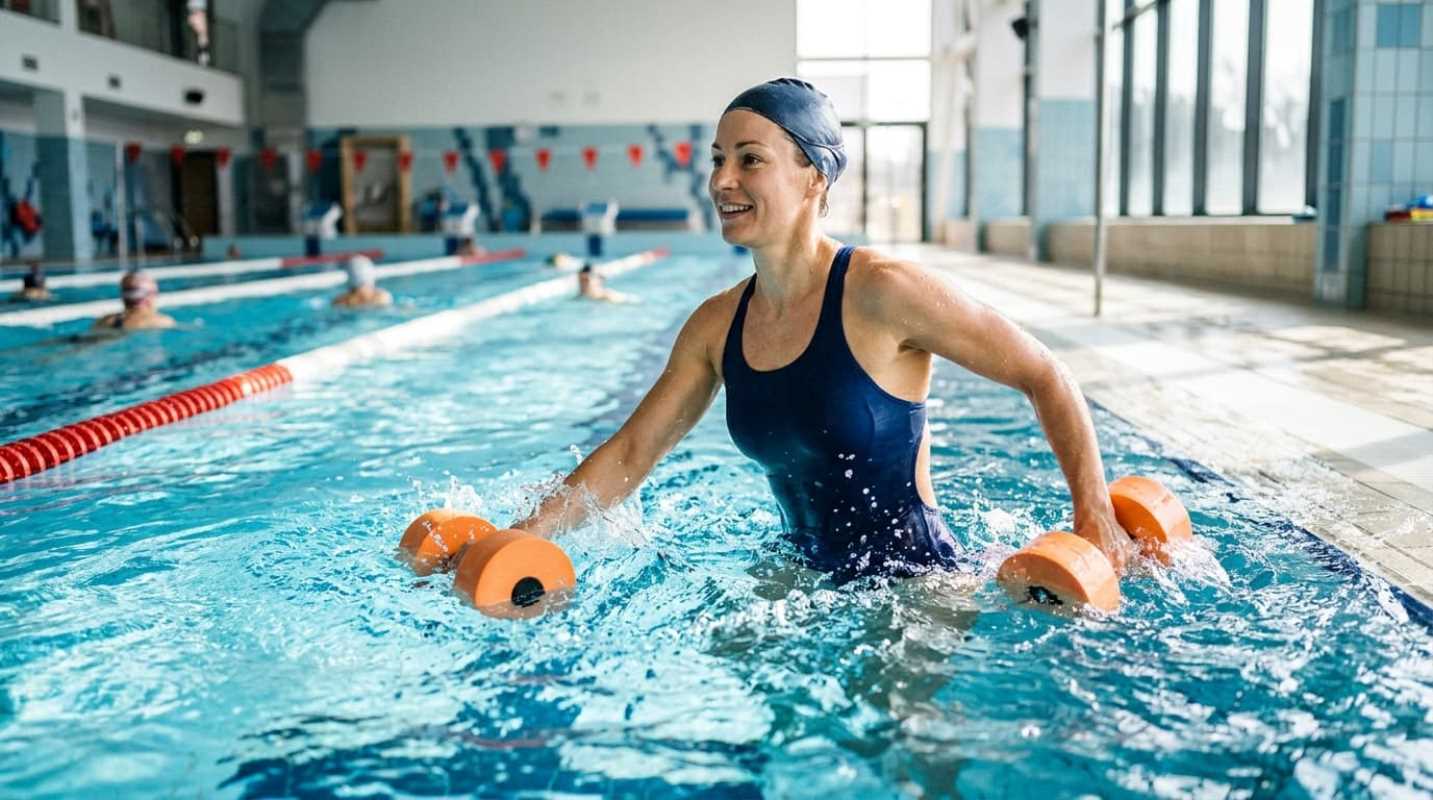
Aqua dumbbells made of closed-cell foam turn traditional weight training upside down. Instead of fighting gravity to lift a weight up, you fight buoyancy to push the foam down into the pool. Shoving foam bells downward sets your triceps and lower pectorals on fire, while guiding them back up with control works your upper back.
Aquatic High-Intensity Interval Training is another phenomenal tool. A study evaluating eight weeks of deep-water running intervals at 80% heart rate reserve found that participants matched the cardiovascular VO2 max gains of intense land-based sprints, but with zero joint pain and far higher workout adherence.
Consistency and Recovery: Making it a Lifestyle
The benefits of pool workouts reach well beyond measurable strength and calorie burn. Water offers an escape from the sensory overload of daily life. The steady rhythm of rhythmic breathing, combined with the muffled soundscape below the surface, produces a meditative focus that relieves mental fatigue.
To turn this into a sustainable lifestyle, treat the pool as a versatile training ground rather than an occasional chore. You can use low-intensity swimming sessions as active recovery between heavy lifting days, flushing metabolic waste from your muscles without adding joint stress. On days when you want a serious metabolic boost, slip on hydro-resistance gear and tackle high-intensity intervals.
Listen to your body, experiment with different strokes and vertical drills, and embrace the fluid resistance around you. Once you experience how light your joints feel and how capable your body becomes, you will never look at pool training the same way again.
Sources:
1. Advantages of Water-Based Exercise
https://www.harvardhealth.org/healthbeat/advantages-of-water-based-exercise
2. Aquatic Exercise Dose-Response Meta-Analysis
https://pubmed.ncbi.nlm.nih.gov/39448717/
3. Systematic Review on Aquatic Exercise and Body Composition
https://www.frontiersin.org/journals/public-health/articles/10.3389/fpubh.2025.1726568/full
*This article on Katiently is for informational and educational purposes only. Readers are encouraged to consult qualified professionals and verify details with official sources before making decisions. This content does not constitute professional advice.*