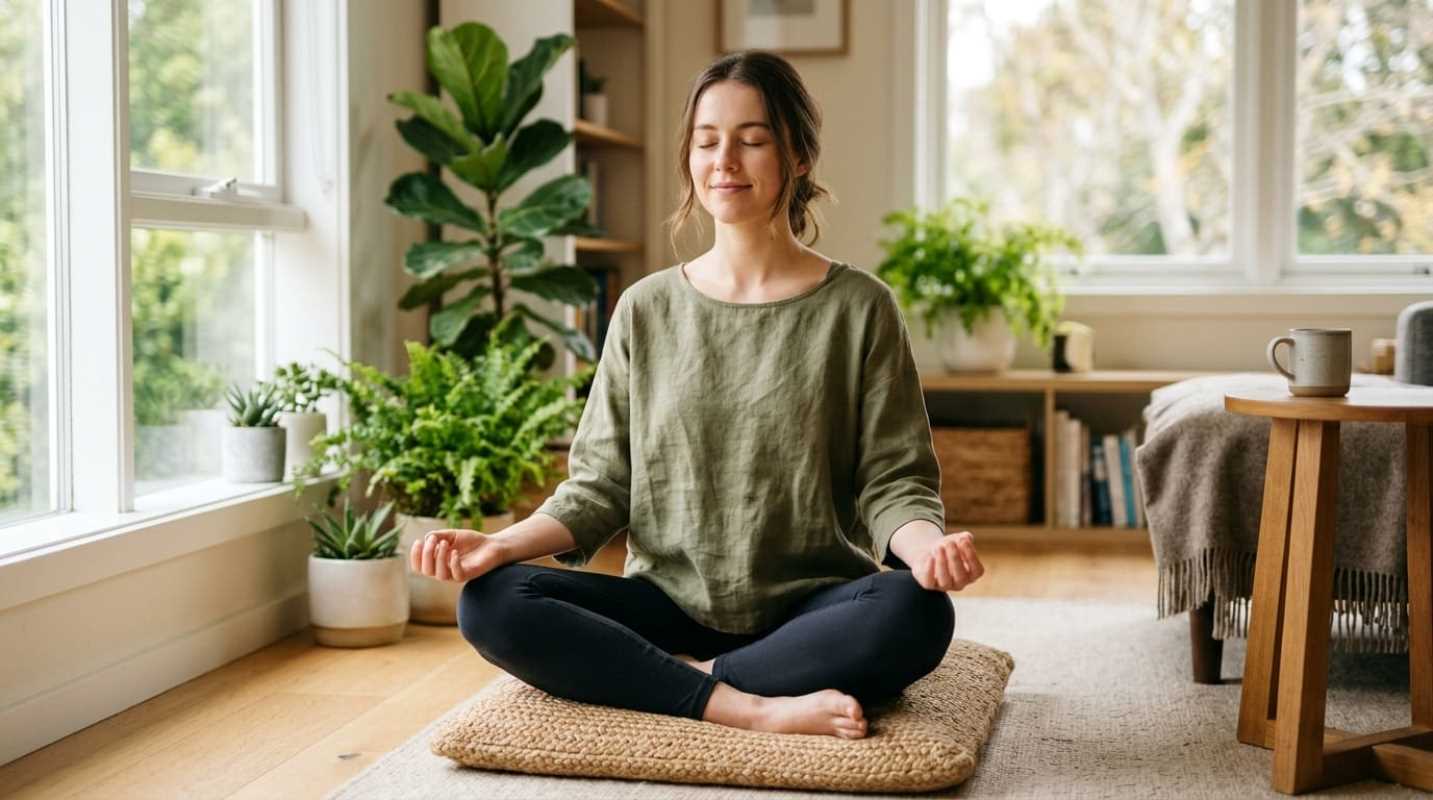
Modern life doesn't give your brain much room to breathe. Between nonstop notifications, work pings, and the background hum of daily responsibilities, your mind spends most of its waking hours in overdrive. You sit down to relax at night, yet your thoughts keep spiraling in circles. Have you been there?
Awareness is simply the practice of paying attention to the present moment on purpose, without beating yourself up when your focus slips. That is it. You might have heard that meditating means sitting in a pretzel pose and turning your brain into a blank slate. That is completely false. Your brain is designed to produce thoughts, just like your heart is designed to beat. Trying to silence every single thought will only leave you frustrated.
The goal is learning how to step back from the mental chatter so it stops bossing you around. According to data from the Centers for Disease Control and Prevention, the share of adults practicing meditation has more than tripled in recent years, climbing well past 14%.¹ People aren't turning to meditation because it looks calm on social media. They are doing it because modern stress demands real, practical tools that actually work.
The Low-Pressure Approach Starting With a Few Minutes
When starting out, consistency beats intensity every single time. Sitting for sixty agonizing minutes on a Sunday afternoon won't do much for your nervous system if you abandon the practice for the next three weeks. On the flip side, committing to five minutes every morning can quietly rewire how you respond to pressure.
Research led by neuroscientist Dr. Amishi Jha shows that twelve minutes a day represents a key threshold for protecting working memory and focus under high stress. But you don't need to begin at twelve minutes. In fact, jumping straight into longer sessions often backfires. Studies show that a daily sit of just five to ten minutes produces noticeable drops in stress and anxiety for newcomers.
Even a single short session has an immediate impact on your biology. In a study published in PNAS, researchers used direct intracranial recordings to measure brain activity during meditation. They found that even first-time meditators showed measurable changes in neural oscillations deep inside the amygdala and hippocampus during a simple five-minute guided track. Your brain starts responding the second you begin.
Understanding the Noise and Overcoming a Wandering Mind
Here is what your first session will probably look like. You close your eyes, take three deep breaths, and feel genuinely peaceful for about eight seconds. Then, out of nowhere, you start thinking about an awkward email you sent yesterday, what to make for dinner, or whether you forgot to pay your electric bill.
When that happens, don't panic or assume you are bad at meditating. A wandering mind is completely normal.
Think of awareness like physical training. When you go to the gym, lifting weights builds muscle. In meditation, realizing that your attention drifted off to your grocery list is the lift. The act of noticing the distraction and gently guiding your attention back to your breath is the mental rep. Every single time you catch yourself daydreaming and return to your anchor, you make that attentional circuit stronger. You aren't failing when you get distracted. You are doing the exercise.
Finding Your Groove With Simple Guided Methods
You don't have to sit in complete silence and figure this out on your own. Guided audio tracks and structured methods take the guesswork out of early sessions. Here are four beginner-friendly ways to practice
• Breath Awareness: Choose a physical anchor, such as the cool air entering your nostrils or the rise and fall of your belly. When a thought pulls you away, simply bring your awareness back to that physical sensation.
• The Body Scan: Slowly sweep your attention through your body, from your toes up to your scalp. Notice areas of tension, warmth, or tingling without trying to fix them. This technique is especially useful before bed because it helps power down physical tension.
• Loving-Kindness: Silently repeat simple, supportive phrases directed toward yourself and others, such as wishing for health, safety, and ease. It sounds simple, but it quickly softens the harsh inner critic running in your head.
• The 5-4-3-2-1 Grounding Method: Open your eyes and mentally name five things you see, four things you feel, three things you hear, two things you smell, and one thing you taste. This is an incredible tool for acute worry when sitting with your eyes closed feels a lot of.
The physical payoffs of these simple routines are backed by rigorous science. In a clinical trial published in JAMA Psychiatry, an eight-week awareness program went head-to-head against escitalopram, a common prescription medication for generalized anxiety.² Awareness matched the medication in reducing anxiety symptoms.³ Even better, zero participants dropped out of the awareness group due to side effects, compared to eight percent in the medication group.
Building a Habit That Actually Sticks
The biggest obstacle beginners face isn't lack of willpower. It's relying on vague intentions like "I'll try to meditate tomorrow." Behavioral psychology offers several reliable ways to turn meditation into an automatic part of your day
• Habit Stacking: Attach your practice to a routine you already do without thinking. Like, tell yourself, "Right after I pour my morning coffee, I will sit on the couch for three minutes."
• The Two-Minute Rule: Shrink the starting hurdle down to almost nothing. Tell yourself you only have to focus on your breath for 120 seconds. Anyone can spare two minutes. Once you sit down, the friction disappears, and you will often want to stay a little longer.
• Implementation Intentions: Decide on the exact time, room, and format ahead of time. Sitting in the armchair in your bedroom at 7:15 AM with headphones is far more likely to happen than a loose goal to sit somewhere later.
Let go of perfectionism. If you miss a day, don't spiral into self-criticism. Just jump back in during your next scheduled window.
Your Journey Toward Mental Clarity
Learning to meditate isn't an overnight transformation, and you won't walk away from your first week feeling like a monk. What you will notice, but are subtle shifts. You might catch yourself pausing before snapping at a rude driver. You might realize your shoulders are hunched up to your ears and consciously drop them. You might notice anxious thoughts without letting them hijack your entire afternoon.
Long-term practice physically cools down your amygdala, the brain's panic button, while building stronger connections to your prefrontal cortex, which handles reasoned decision-making. That means less reactive panic and more emotional balance.
Be patient with yourself as you build this skill. You don't need a meditation cushion, special incense, or thirty minutes of uninterrupted silence. You only need a few minutes and a willingness to sit with your experience as it is. Take a slow breath, drop your shoulders, and start your first two minutes today.
Sources:
1. Use of Yoga, Meditation, and Chiropractors Among U.S. Adults
https://www.nccih.nih.gov/research/statistics/NHIS/2017/Meditation-Use-US-Adults
2. Awareness-Based Stress Reduction vs Escitalopram for the Treatment of Adults With Anxiety Disorders
https://pubmed.ncbi.nlm.nih.gov/36350591/
3. Treating Anxiety Disorders With Awareness
https://today.advancement.georgetown.edu/health-magazine/summer-2023/2023/treating-anxiety-disorders-with-awareness/
*This article on Katiently is for informational and educational purposes only. Readers are encouraged to consult qualified professionals and verify details with official sources before making decisions. This content does not constitute professional advice.*