 (Image via
When you want to get a serious workout in before tackling the day's adventures, but the idea of searching for a local gym feels like a hassle, and doing endless push-ups on the rug doesn't quite scratch the itch for a real strength challenge, there's another solution. You can always try one of the most useful pieces of equipment: the kettlebell. This cannonball-shaped weight with a handle is the ultimate travel companion for fitness enthusiasts who refuse to compromise on their strength training. Unlike a set of dumbbells or a bulky barbell, a single kettlebell takes up minimal space—you can easily toss one in the trunk for a road trip or find them in even the most modest hotel gyms—yet it offers a dynamic, full-body workout that rivals any machine-filled fitness center.
Why the Kettlebell is the Ultimate Travel Tool
When you are constantly on the move, efficiency is everything. You don't have hours to waste isolating individual muscles with bicep curls or leg extensions. You need a tool that hits everything at once, building strength, endurance, and flexibility in a single session. The kettlebell is uniquely designed for this purpose. Because the center of gravity is offset from the handle (unlike a balanced dumbbell), your body has to work harder to stabilize the weight. This engages your core, your grip, and all those tiny stabilizer muscles that often get neglected.
For a traveler, this translates to real-world functional strength. Think about lifting a heavy suitcase into an overhead bin or stabilizing yourself on a rocking boat. These movements require your body to work as a single, cohesive unit. Kettlebell training mimics these demands perfectly. Plus, the dynamic nature of exercises like the swing or snatch gets your heart rate up fast, giving you a cardio workout without ever stepping foot on a treadmill. It is the perfect two-for-one deal: strength and conditioning in a compact package.
The Fundamentals of Kettlebell Training
Before you start swinging a heavy weight around your hotel room, it’s crucial to understand the mechanics. Kettlebell exercises generally fall into two categories: "grinds" and "ballistics."
Grinds: Controlled Strength
Grinds are slow, controlled movements where you maintain tension throughout the lift. Think of a squat, a press, or a deadlift. These exercises build raw strength and muscle mass. For travelers, grinds are excellent because they don't require a lot of space. You can do a heavy goblet squat in a space no bigger than a phone booth.
Ballistics: Explosive Power
Ballistics are fast, explosive movements where you accelerate the weight. The classic kettlebell swing is the prime example. These exercises build power, speed, and cardiovascular endurance. They teach your body to generate force from the hips—the engine of your body—which is vital for hiking, running, and just generally moving well through the world.
The "One Kettlebell" Full-Body Workout
You don't need a whole rack of weights. A single, moderately heavy kettlebell (16kg for men and 12kg for women is a standard starting point) is enough to challenge every muscle in your body. This routine is designed to be done anywhere, anytime.
1. The Goblet Squat (Legs, Glutes, and Core)
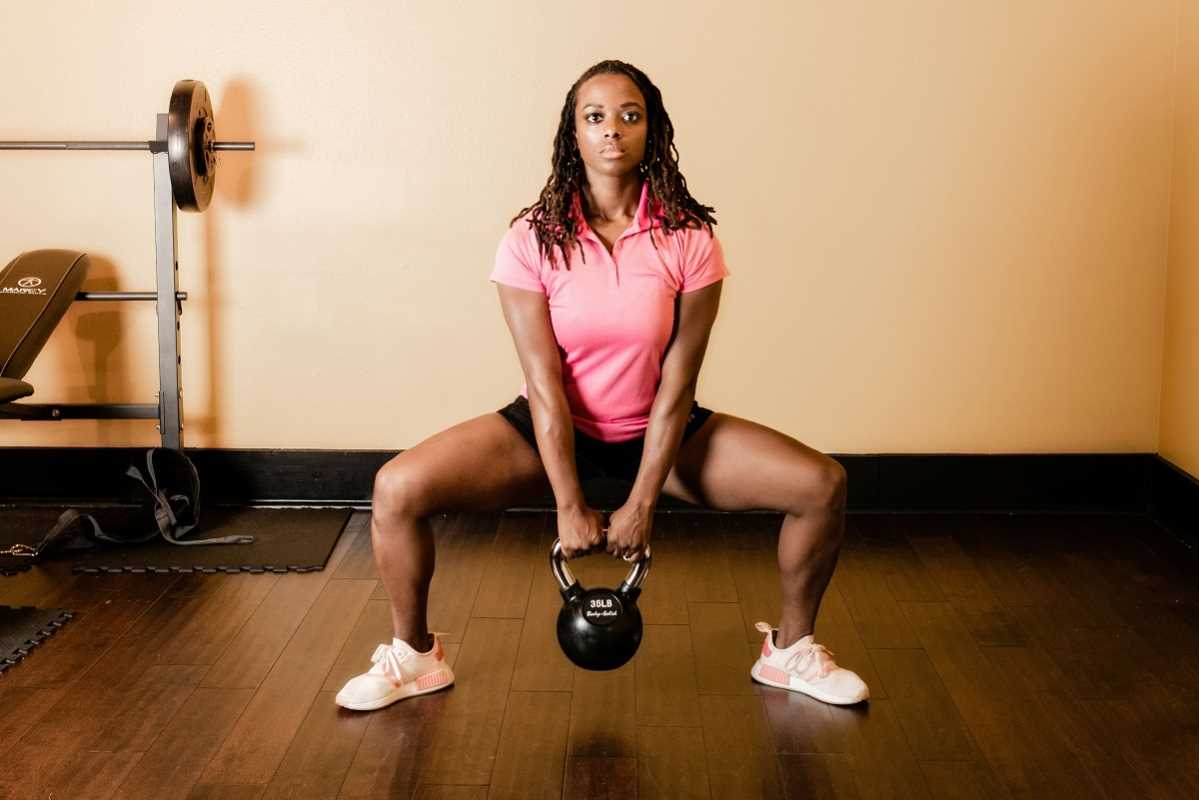
This is the king of squat variations for travelers. By holding the weight in front of your chest, you automatically counterbalance your body, allowing you to squat deeper with better form.
- How to do it: Hold the kettlebell by the "horns" (the sides of the handle) close to your chest. Stand with your feet shoulder-width apart. Lower your hips back and down as if sitting in a low chair, keeping your chest up and your elbows inside your knees. Push through your heels to stand back up.
- Travel Benefit: This builds the leg strength needed for long days of walking and climbing stairs in old European cities.
2. The Single-Arm Overhead Press (Shoulders, Triceps, and Core)
Lifting a heavy object overhead is a fundamental human movement. Doing it with one arm forces your core to work overtime to keep you upright, preventing you from leaning to the side.
- How to do it: Clean the kettlebell to the "rack position" (resting against your forearm and bicep at chest height). Brace your abs and press the weight straight up until your arm is fully extended by your ear. Lower it back to the rack position with control.
- Travel Benefit: Essential for lifting luggage. If you can press a 16kg kettlebell, that 10kg carry-on will feel like a feather.
3. The Kettlebell Swing (Posterior Chain: Hamstrings, Glutes, Back)
If you only do one exercise, make it the swing. It strengthens the entire backside of your body, which often gets weak from sitting on planes and trains. It also torches calories.
- How to do it: Stand with feet wider than shoulder-width, kettlebell on the floor in front of you. Hinge at the hips (don't squat) to grab the handle. Hike the bell back between your legs like a football snap, then explosively snap your hips forward to float the bell up to chest height. Let gravity bring it back down and repeat.
- Travel Benefit: This is the antidote to "traveler's back." It strengthens the muscles that support your spine and improves your posture.
4. The Kettlebell Row (Back, Biceps, and Grip)
Pulling strength is vital for posture and shoulder health. The row targets the lats and the muscles between your shoulder blades.
- How to do it: Place the kettlebell on the floor. Stagger your stance, with your left foot forward and right foot back. Rest your left forearm on your left thigh. Grab the kettlebell with your right hand. Pull the weight up toward your hip, squeezing your shoulder blade back. Lower it with control.
- Travel Benefit: Helps counteract the rounded-shoulder posture we often adopt when looking at phones or carrying backpacks.
5. The Halo (Shoulder Mobility and Core)
This often-overlooked exercise is fantastic for warming up the shoulders and strengthening the core from all angles.
- How to do it: Hold the kettlebell by the horns upside down (bottoms up) at chest level. slowly circle the weight around your head, keeping it as close to your neck as possible. Keep your torso completely still; only your arms should move.
- Travel Benefit: Keeps your shoulders mobile and pain-free, which is crucial if you're planning on swimming or surfing during your trip.
Structuring Your Travel Workout
The beauty of this routine is its flexibility. Depending on your schedule and energy levels, you can adapt the structure.
- For a Quick Burn: Perform each exercise for 40 seconds, followed by 20 seconds of rest. Do 3-4 rounds. This takes less than 20 minutes and will leave you drenched in sweat.
- For Strength: Perform 5 sets of 5-8 reps for the grinds (squat, press, row). Rest for 90 seconds between sets. Finish with 5 sets of 15 swings.
- The "Ladder" Method: Start with 1 rep of each exercise, then 2, then 3, working your way up to 5, and then back down to 1. This is a great way to sneak in a lot of volume without it feeling overwhelming.
Taking Your Kettlebell Game on the Road
While carrying a 35-pound iron ball in your checked luggage might push the weight limit (and annoy the baggage handlers), there are travel-friendly options.
Adjustable Kettlebells
Several companies make adjustable kettlebells that allow you to change the weight with a dial or pin. While still heavy, one adjustable bell replaces an entire rack, making it a viable option for road trips or long-term stays where you have a car.
Kettlebell Sandbags or Dry Bags
This is the ultimate hack for the light packer. You can buy a durable, handle-equipped bag that is designed to be filled with sand or gravel. Pack it empty—it weighs almost nothing—and when you arrive at your destination, head to a beach or a hardware store to fill it up. Voila! You have a heavy kettlebell that cost you zero baggage fees.
The "Water-Bell"
Similar to the sandbag, there are collapsible plastic or rubber vessels that you can fill with water to create weight. Water moves around, creating "live" weight that challenges your stability even more than iron. It’s perfect for hotel room workouts.
Safety First: Mastering the Form
Because kettlebell movements are often dynamic, form is paramount. A sloppy swing can tweak your back, putting a damper on your vacation.
- Start Light: If you are new to a movement, practice with a lighter weight or even a water bottle first to get the mechanics down.
- Focus on the Hips: For swings and cleans, the power comes from the hip snap, not the arms. Your arms are just ropes connecting your body to the weight.
- Keep a Flat Back: Never let your spine round, especially during swings and rows. Imagine you have a rod taped to your spine.