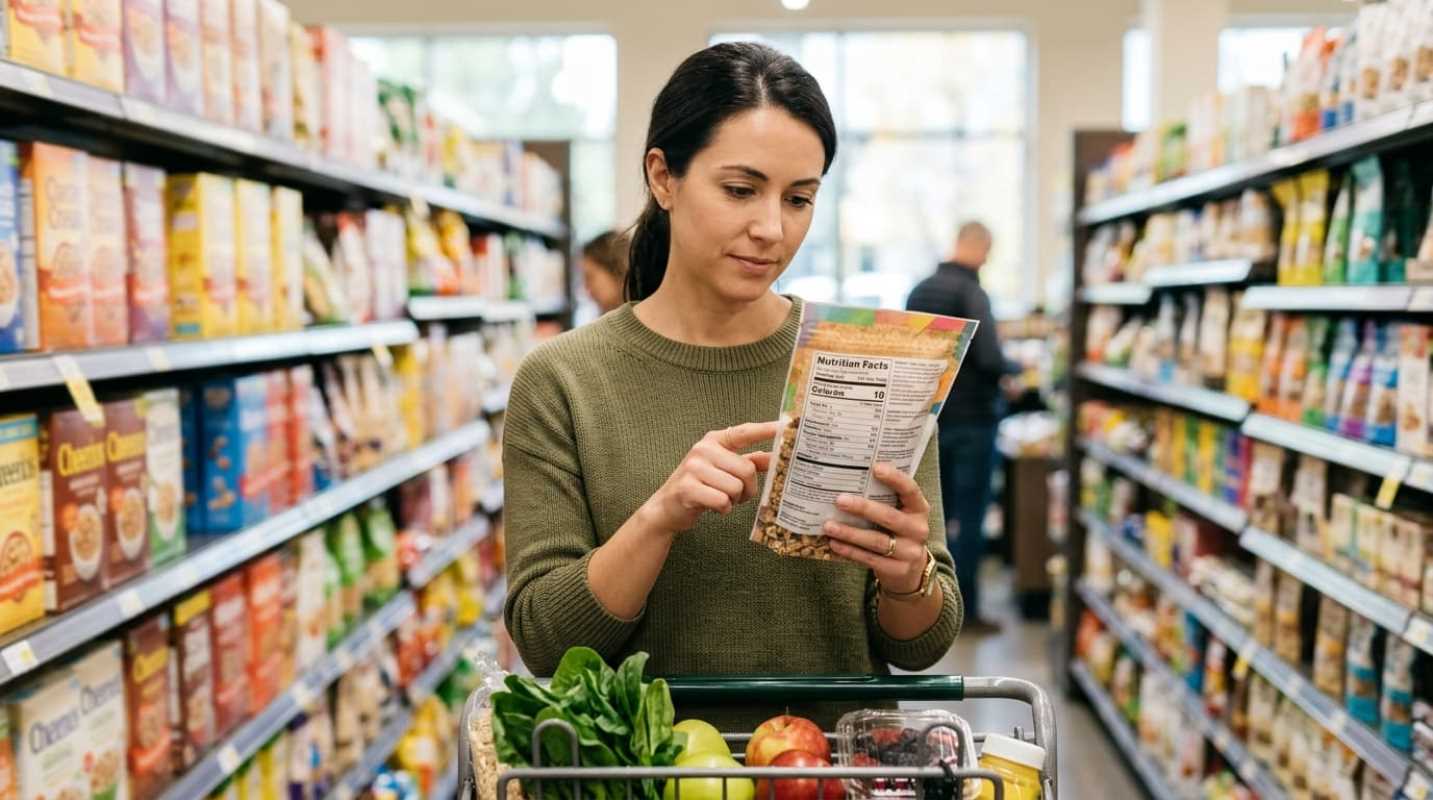
Ever stood in the cereal aisle staring at a brightly colored box that promises whole grains, heart health, and boundless energy? You want to make a smart choice, but the packaging throws half a dozen buzzwords in your face before you even find the price tag. Have you been there?
You aren't alone. An FDA survey found that 87% of American adults check the Nutrition Facts panel, yet nearly 59% admit that food claims and nutrition panels are difficult or confusing to handle.¹ The front of the package looks like a personal wellness cheerleader, but the real story sits quietly on the back.
Food literacy in 2026 means seeing through that glossy graphic design. Think of the label as a roadmap. Once you know how to read the terrain, you stop falling for slick marketing traps and start putting food in your cart that actually matches your personal goals.
The Numbers Game and Decoding Serving Sizes
The most overlooked line on any package sits right at the very top: the serving size. It sounds obvious, but it trips up almost everyone.
Food companies do not set serving sizes based on what you should eat, or even what a normal person eats in one sitting. By law, serving sizes reflect what people historically consume on average. Manufacturers frequently manipulate these numbers to make a product look healthier than it is.
Imagine picking up a 16-ounce bottled iced tea. You glance at the label, see 80 calories and 20 grams of sugar, and think that sounds reasonable. Look closer. The bottle holds 2.5 servings. If you drink the whole bottle, you are actually taking in 200 calories and 50 grams of sugar. That is the classic multi-serving trap.
Here is another subtle trick: rounding rules. Federal regulations allow food manufacturers to round any nutrient down to zero if a single serving contains less than 0.5 grams. If a brand wants to advertise zero grams of trans fat or zero grams of sugar, they simply shrink the suggested portion down to a microscopic size, like two small crackers or a single breath mint.
You end up eating four or five servings, and suddenly you have consumed several grams of an ingredient you thought you avoided completely. Always check the total servings per container first, then multiply every single number by the portion you realistically plan to eat.
The Truth Behind Ingredient Lists
If you want the unvarnished reality of what is inside a package, skip the fancy tables for a moment and look directly at the ingredient statement.
Under federal law, ingredients must appear in descending order by weight. The first three ingredients make up the vast bulk of what you are eating. If sugar, refined vegetable oil, or enriched bleached flour occupy those top spots, you are holding a heavily processed item, regardless of whatever feel-good claims are plastered across the box.
Watch out for a common corporate sleight of hand known as sugar splitting. Manufacturers know that shoppers scan the top three ingredients for the word "sugar." To keep sugar from appearing near the front of the list, a company will split their sweeteners across four or five different varieties.
They might use cane sugar, brown rice syrup, dextrose, and concentrated fruit juice. Because each sweetener is weighed individually, every single one sinks lower down the list. But if you combined them, sugar would easily be the primary ingredient.
A reliable shortcut is to look for the phrase "Contains 2% or less of." Anything listed after that phrase is present only in trace amounts. That is where you will usually find synthetic preservatives, leavening agents, and artificial flavorings. If a brand advertises real blueberries on the front, but blueberries appear after the 2% mark, you are mostly eating dyed corn starch with blueberry flavoring.
Spotting Misleading Claims and Marketing Traps
In the grocery store, the front of the box is for selling, and the back of the box is for telling. The front is pure advertising real estate, carefully engineered to create a health halo around ordinary junk food.
To protect your wallet and your health, you need to understand how the FDA categorizes package claims. They fall into three basic tiers
• Authorized health claims: These carry the highest regulatory hurdle. They require solid scientific agreement proving a direct link between a nutrient and a disease risk, like the connection between low-sodium diets and reduced blood pressure.²
• Nutrient content claims: These use strictly defined thresholds. Words like "fat-free," "low sodium," or "high fiber" must meet specific legal standards. Keep in mind that fat-free candy can still be 98% pure sugar.
• Structure and function claims: This is where marketing runs wild. Phrases like "supports immunity," "boosts ," or "promotes digestive wellness" do not require prior FDA approval. A sugary cereal can claim to support immunity simply because the manufacturer sprayed a tiny amount of synthetic vitamin C onto the grain flakes.
The word "natural" remains one of the biggest illusions on supermarket shelves. The FDA has never created a formal, binding legal definition for "natural." It simply means nothing synthetic was added during manufacturing. A package labeled natural can still be packed with sodium, saturated fat, and ultra-processed syrups.
Fortunately, regulations have tightened up. The FDA finalized a strict standard for using the word "healthy" on packaging.³ Under these updated rules, products must contain a meaningful amount of a core food group like whole grains, lean protein, fruit, or vegetables, while staying under strict caps for added sugars, sodium, and saturated fat.
Practical Approaches for Your Next Grocery Run
Turning food labels into your personal secret weapon does not require a degree in biochemistry. You just need a simple checklist when you walk through the aisles.
First, lean into the 5/20 rule for Percent Daily Value (%DV). It is the fastest shortcut on the panel. A Daily Value of 5% or less means that food is low in that nutrient. A Daily Value of 20% or more means it is high. You want to see 5% or less when looking at saturated fat, sodium, and added sugars. You want to see 20% or more when looking at dietary fiber, potassium, calcium, and iron.
Second, look closely at the indented line under Total Carbohydrates that reads "Includes [X]g Added Sugars." Natural sugars occur naturally in fruit and plain dairy alongside beneficial nutrients. Added sugars are tossed in during manufacturing. Aim to keep your added sugar intake under 25 grams daily if you are a woman, or 36 grams daily if you are a man.
Third, try the five-ingredient guideline for packaged snacks. Although not an absolute law, products with five or fewer recognizable, whole-food ingredients are generally less processed and offer higher nutrient density than items having forty unpronounceable compounds.
Building this label-checking habit takes just ten extra seconds per item. Pick up the box, flip it straight to the back, check the serving size, check the 5/20 numbers, and read the first three ingredients. You take full control of your nutrition the moment you decide to stop buying the front of the box.
Sources:
1. Food Safety and Nutrition Survey Report
https://www.food-safety.com/articles/7025-fda-releases-results-of-2019-food-safety-and-nutrition-survey-report
2. Fine Line Between Fact and Fiction in Marketing Claims
https://extension.unh.edu/blog/2024/02/fine-line-between-fact-fiction-marketing-claims-food-products
3. FDA Finalizes Healthy Claim
https://www.khlaw.com/insights/fda-finalizes-healthy-claim
*This article on Katiently is for informational and educational purposes only. Readers are encouraged to consult qualified professionals and verify details with official sources before making decisions. This content does not constitute professional advice.*